Overview
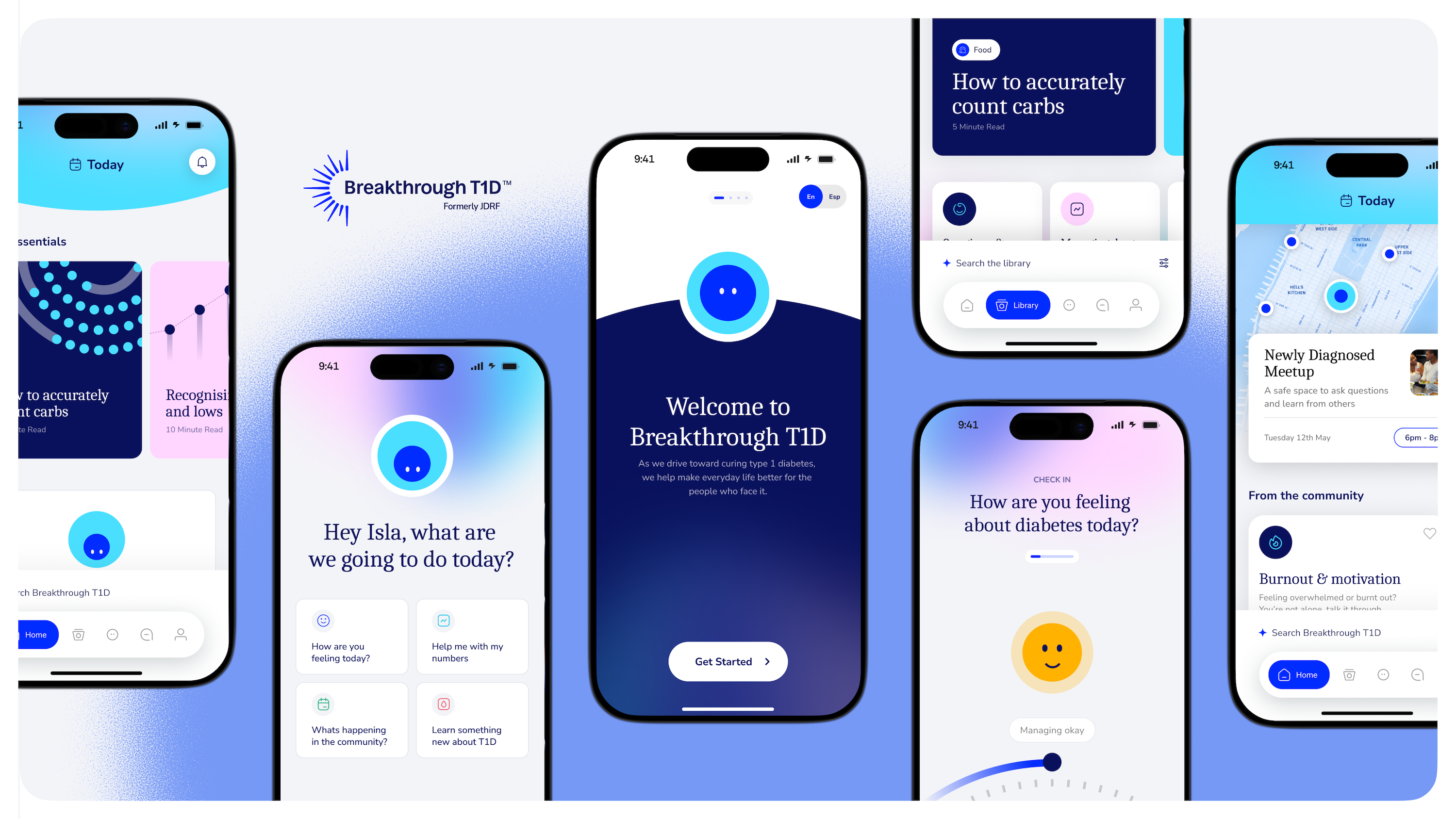
We were engaged to create the product strategy and technical design for a first of its kind mobile app leveraging AI alongside the supportive services and content already native to the web experience of this global health charity.
My Role
I led a strategy and design engagement defining a net-new mobile product centring an AI-native experience in a community-saturated competitive landscape.
- Owned core deliverables end to end: product audit, UX research synthesis, competitive analysis, MVP scope, product roadmap, and guided high-fidelity designs for core screens.
- Set the MVP strategy around a personalized AI companion as the product's differentiator, positioning against a market crowded with community features but absent of personalization.
- Designed the V1 AI architecture: a conversational model paired with a lightweight classification model for routing and emotional-state grading, plus a phased memory and personalization model scoped from session-only at MVP to a full user knowledge repository in later releases.
- Defined product foundations including a five-tab information architecture, bilingual English/Spanish support from launch, connected parent-child accounts for teen inclusion, and a single content source of truth.
- Assessed an enterprise nonprofit tech stack (Salesforce, marketing automation, data warehouse, content and forum platforms) and designed the app to route fundraising, events, and community through existing infrastructure rather than rebuild it.
- Coordinated a cross-functional team across UX research, product design, and project management, and navigated a multi-level client stakeholder structure spanning executive sponsorship, technology leadership, and operational counterparts.
The Problem
There are 9.5 million+ people living with type 1 diabetes worldwide, and that number is climbing — up roughly 13% since 2021. For most people, a T1D diagnosis arrives out of nowhere and carries an immense emotional burden and significant cognitive weight.
No two individuals share the same journey. Someone three days post-diagnosis and someone ten years into treatment are very different users who may access the same platform, but require a unique and personalized experience. They need different responses, in different tones, at different moments. Most products in this space fail to deliver the level of personalization and support afforded by modern AI architectures. The market is community-saturated and personalization-empty, competing primarily on features such as forums, feeds, and content. Almost nobody leads with an experience that adapts to the specific human using it.
TLDR:
- ~9.5 million people live with T1D globally, and it's rising ~13% since 2021
- Two people with the same diagnosis can have completely different needs
- The market is community-saturated and personalization-empty
The Bet
We bet on a personalized AI companion present across the entire experience in a way that is native, subtle, and personal. It is your personal and adaptive guide woven into the experience while also accessible through a dedicated space where you can talk, journal, and reflect. It runs onboarding, curates what you see day to day, and points you toward the right content and next step available for treatment.
I anchored personalization on three axes: who you are (your unique persona), why you're here (as a patient, advocate, fundraiser), and time since diagnosis (for you or the loved one in your life). People at different stages require a different guide, with each suggestion grounded in the user's unique position in their journey with the disease. The organization has a rich history and a robust set of services already including events, community, and vetted expert content. The app's job is to route what's already delivered by the organization through a set of smart digital doorways guided by the AI guide. The aim for V1 was to establish a relationship of trust by being useful and personal first, then introduce the more robust clinical offerings in later build phases.
TLDR:
- Lead with a personalized AI companion, not community breadth
- Personalize on who you are + why you're here, modified heavily by time since diagnosis
- Route fundraising, events, and community through existing infrastructure — don't rebuild it
- Defer clinical disease management to a later phase
AI Companion
I designed a multi-model architecture to provide personalization to the user and adaptation to the user's cognitive and emotional states when interacting with the app, along with a phased approach to the agent's memory. For models, we chose Sonnet as the primary and Claude Haiku to handle classification and emotional-state grading, with OpenAI GPT as a warm fallback. Sonnet follows nuanced instructions, refuses medical advice cleanly while staying warm, and modulates tone; Haiku is fast and cheap enough to run on classification tasks; GPT covers an Anthropic outage.
Architecture
The LLM is never called directly from the mobile client. Keys, rate limits, prompt-injection defence, cost, observability, PII scrubbing, moderation, and evaluation all live on the backend. The app talks to an orchestrator; the orchestrator talks to the models.
Retrieval (RAG over WordPress)
My approach was to have WordPress stay the content source of truth. A scheduled REST pull normalizes content to Markdown, chunks it (~500 tokens, 50 overlap, section-aware), and embeds it into pgvector. Each chunk carries metadata: source URL, last-modified, content type, provenance (expert-verified / org-vetted / community-contributed), and locale. Retrieval is hybrid — pgvector ANN plus Postgres tsvector full-text, reranked, top-8 into the prompt. Library-mode answers cite the WordPress sources beneath the response; if retrieved content doesn't cover the question, the AI says so rather than inventing an answer.
Guardrails (layered)
- Input classifier — flags self-harm, acute medical symptoms, dose requests, minor-in-distress; each routes to a template.
- Topic allowlist — the companion stays within the organization's content scope; out-of-scope queries redirect warmly to care team + content.
- T1D/T2D hard rule — never conflate the two; ambiguous queries get a clarifying question, not an assumption. (UXR flagged this as the fastest trust-loss trigger for adult T1D users.)
- No clinical recommendations — never suggests doses, interprets labs, diagnoses, or tells users to start/stop medication.
- Age-appropriate mode — under-18 users get a stricter prompt, stricter thresholds, no substance/weight/disordered-eating content.
- Source citation enforcement — Library answers cite their WordPress sources; no-source answers are flagged.
- Emotional-state modulation — Haiku's grade adjusts tone; never celebratory when the user is hurting.
- Crisis pathway — self-harm or acute medical signal triggers a scripted response with 988 + Crisis Text Line, and pauses the thread until the user confirms safety.
- Prompt-injection hardening — retrieved documents are wrapped in tags; the model is instructed to ignore any instructions inside them.
- Disclaimer injection — contextual footer on health-adjacent responses, not every turn.
- Character guardrails — voice and tone boundaries from the client's brand team (open question).
Memory
Minimal at MVP (15-minute idle timeout, no raw transcripts in the database). At v1, opt-in persistent memory as a compressed summary rebuilt every N turns and capped ~500 tokens, which the user can view and correct in the Account tab; raw transcripts kept 30 days max, only if opted in. Context handled by rolling summarization at ~70% of the model's context limit.
Evaluation and cost
A ~100-prompt golden set curated with the organization's content and clinical advisory covers content Q&A, wayfinding, crisis signals, out-of-scope, pediatric, prompt injection, and T1D/T2D disambiguation. Metrics: retrieval precision@5, answer faithfulness (LLM-as-judge), safety pass/fail, tone match. Regression runs on every prompt or model change, with deploys blocked on safety regressions. Modeled cost is ~$1,400/month at 10K MAU on a 70/25/5 light/medium/heavy split, held down by per-user daily caps and pushing classification to Haiku; the GPT fallback at ~10% is roughly cost-neutral.
Conclusion
The scope of this engagement covered strategy and design, and the architecture I proposed is set to deliver a truly unique and personalized mobile experience for this important global community.
Engagement led at Fueled. Some product and client details are intentionally held while the work is unreleased.